Some of the
images on this pages are wide - use your horizontal scroll bar.
I returned to the Philippines to get a taste of the resorts in Palawan,
specifically El Nido's Lagen
Island (600$/night) and Dolarog
($160/night), followed by a return to Ilocos Norte
again. The country is very inviting and its people most friendly, so it
was an easy choice as a holiday destination,
particularly with friends there.
In the province of Ilocos Norte, I once again stayed at the fort Ilocandia
(visible in goodle
maps), near the province's largest city and capital Laoag.
I was fortunate enough to *borrow* a Mitsubishi Lancer car from an acquaintance, whose front hood was dented when a moron at the fort
backed up his 4x4 into it (spare tire), costing me 4000 pesos at a body
shop. Driving in the Philippines is a riot, dodging trucks, tour buses,
cars, bikes and motorized tricycles - and they are not used to our
fast and aggressive driving. I often visited the tiny village of Lubnac
(see panorama below), in the municipality (barrio) of Vintar,
nestled on a mountain overlooking a valley. There are perhaps 50 people living there, mostly children,
5 to a family, in
unfinished
cinder block homes with tin roofs. Most have a family member living in
Hawaii or California, helping somewhat with their very poor situation.
They were most friendly, all smiles for the rarity that I
was, a foreigner in their midst. The sense of community in the village
is remarkable: it was not uncommon to see a hoard of them enjoying
themselves chatting away in the shade on day after day of glorious
blue skies. For all their want to come to America, they have it far
better than what I have, living in this gorgeous landscape and sharing
like we never have. Resourceful and bright, they underlined the
west's neurotic and deluded ceaseless building of the
consumption monster. Sadly, the evils of coke, Pepsi, Marlboro and
alcohol,
all machinations of the west, are ever present, eating away 50%
of
their measly earnings. We'll
revert to their way of living when petrol runs out 100 years
hence - no amount of alternative energies can
feed the monster.
A stream down by a small bridge is used for washing clothes and dishes,
and the women, traditionally, wash themselves naked there. It was
littered with Frito Lay (potato chip) wrappers and soda pop
bottles, western art. Venomous snakes hide about in the bushes.
Fresh
water is pumped up from deep wells for cooking and
drinking, kept in large rusting barrels and plastic jugs. Despite
their
tossing of wrappers and pop cans in nature, their ecological foot print
is a tiny fraction of my countrymen.
In my honour, they clubbed a *bad* dog to death and
cooked it. It tastes somewhat like beef. It is a free meal for them, as
a goat or pig costs 40$ and 70$ respectively, a fortune. The
village 45 revolver toting captain gave the go ahead to bring down the
misbehaving dog, after repeated warnings to the *owner*. The men in
particular revel in preparing and eating dogs.
A view of part of the village, looking down into the valley. The car is
the machine I drove about the area.
The village primary school kids sang from house to house for a
few pesos - I of course was their intended target as I ran out the
backdoor and to the front of the house to snap them (the front door was
clogged with the happy faces). The Philippinos are adorably shy, at any
age, and I have a very soft spot for them all.
The village is surrounded by bushes and trees with all manner of
commestible fares, such as these watermelon sized Papayas. Sadly, they
prefer to drink soda pop rather than vitamin, mineral and fiber rich
fruits.
Karaoke,
one of my most hated human *inventions* is omnipresent in the
Philippines, here in the cinder block home on DVD for kids to start a
lifelong *talent* for it. I have, if you'll permit, a perfect ear, so
even the slightest singing off key is like fingernails on a blackboard.
Wherever I went, the women and children were sure to congregate. The
men and older boys disappeared and drank San
Miguel beer (Philippino
product) which I sometimes had to foot the bill for (24 bottles per case).
The village is surrounded by many farm fields which they labour over
most
of the day at 100 pesos a day (2.5$). Beautiful in the mountain setting.
At a local 4x4 event, a mechanical shovel was used to remodel the land
for testing the agility of men and machine. However, when I showed up,
all eyes, some 500, where on me. Foreigners in these parts
are exceedingly rare, as in never. But a British man I kept hearing
about by the village people finally strode up behind me with his
emaculately groomed dog on a leash (dogs are often clubbed and cooked
for a village feast otherwise), and after 3 minutes of comical silence,
I introduced myself and had a great time chatting with him. Of course
we were very much scrutinized. On the right, the eyes! A fraction of them.
Cats are *tolerated* as they snatch up small lizard pests, but are
constantly harassed by the kids, or flicked unceremoniously
out of the way by the women. The cat tail is a fraction of the
length of my pets! This little female would instantly bite, but after
much petting
and affection, I finally got it to purr, and soon the kids imitated me, probably never having pet a cat in their life.
Before my visit to the north of the Philippines, I had visited the Palawan
province, specifically the tiny sandstone encircled town of El Nido and
it's aforementioned resorts of Dolarog and Lagen island. The fastest
way into the tiny airport of El Nido which runs out into the ocean at a
beach, is via the ITI
island hopper on a Dornier 228 turbo prop. ITI and Lagen
island resort are owned by the 10 knots corporation and are
outrageously over-priced.
Otherwise it is a weekly one day long boat ride from Manila.
El Nido
was named by the Spanish after the swallow's edible nest found in the
sandstone cliffs, a *delicacy* the Chinese so long ago
discovered or invented.
The landscape out of the Dornier's window is beautiful, even on an
overcast day, promising wonderful waters.
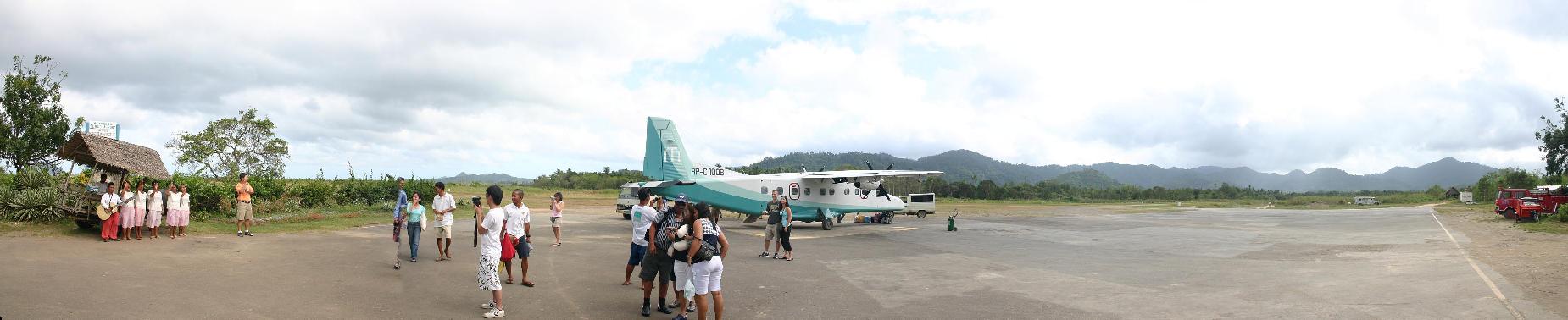
EL Nido's airport and the bull pulled cart welcoming commity. Cute. The
end of the gravel runway runs into the ocean and beach. The Dornier
lands and takeoffs by the beach end as the landscape on the other end
is tight.
A few kilometers further is the El Nido town proper. It is surrounded
by sand stone cliffs and ocean. Perhaps a 1000 inhabitants, no banks,
no ATMs (cash dispensers), I have no idea how they manage their pesos.
You'll find
here foreigners, mostly Europeans, who visited and stayed,
enchanted by the region.
While sipping a good Calamansi (tiny lime like fruit) juice
and chowing down on Pinakbet
(a common vegetable and meat dish), a local fisherwoman (!) came into
the cafe and sold this rather large and fresh fish to the
cafe - that ain't the way it's done in my world, where middlemen
undercut...
Typical *jungle* trail left - and this is typically what Philipinnos do with their hoofed animals - tie
them up near a road side ditch or other murky body of water, for days.
The resorts can only be reached by boat from El Nido. Typically driven
by noisy and noxious diesel engines. The larger boats, I
suspect,
are bus engines and transmissions as I distinctly heard the grinding of
gears as they would put them in reverse.
A 300 mm lens shot of a sleeping boat.
The first resort is the insanely overpriced Lagen island (600$/night)
which has some 5 employee per guest, and where morning and afternoon
activities are planned to the minute. They seemed to know where I was
at any moment! The place is crowded with young Japanese, Korean and
Chinese honeymooners - I was most out of place. I had the
third water villa from the left in the photograph. The resort
is far more extensive than in the picture. Staff are courteous and
professional, but the Philippino smile and relaxed atmosphere I have
grown to know is most absent here, only when you befriend staff on
*activity* islands does it surface. After blowing 2000$ on three
nights, I was glad to escape this activity driven stressful place for
the more relaxed primitive conditions of the Dolarog resort. I do NOT
recommend this resort, despite having enjoyed it, as there are
other cheaper ways to absorb the El Nido nature reserve. Besides, the
air conditioning in the concrete water villas was incompatible with my
health, and as loud as a diesel engine.
The Lagen walk in shower - quite a pleasing affair...
particularly its shampoo and body gel containers, which I did not use!
I put my Canon 300D to capturing timelapses of the El
Nido skies. I
ran out of good evenings to create better ones - another reason to
return!
A Dolarog sunset. Even at 160$ a night, an outrageous price, I favour
this *resort* as it is tiny, extremely quite and peaceful, and the only
way to live it is in a hammock. It is owned by an
Italian having
left Italy for this and a Philippina in 1987. I can't blame him.
Approaching Dolarog by boat. Unusually strong typhoons have wreaked
havoc on the region - damaging most corals and knocking out Dolarog's
pier. Electricity is by diesel generator, and that only 6 or
so hours a day, quite dark and silent most of the day. The
cabanas have louvered walls that can be opened causing a
delightful
breeze to refresh the air inside on 24 hours, blowing away mosquitoes
and no see 'ems, and far better and ecological than air conditioning,
re: Lagen island's noisy water villa aircon.
Aaaaaahhhh.... evening palms over the cabana.
Near Dolarog is the village of Coreng Coreng - tiny, lovely.
Some video footage of the trip. Practically nothing other than the
island hopper flights as I just plain forgot what with the beauty of
the place.
A refreshing late afternoon boat ride.
Approaching the Lagen resort installation on the island of Pangulasian,
where a delightful buffet lunch is served between morning and afternoon
activities. Off shore shorkeling is quite good, and the waters are
light green crystal clear, warm, paradisical.
A fraction of the Pangulasian island installation.
My foot in restive warm waters. - I did not want to leave!
I adore catamarans - here's a Hobie cat 16's main sail and jib. The
swells were 3 feet and a riot.
It took convincing but Raynan (left) and Dennis finally let me govern
the cat. Catamaran in the Tagalog language means lazy!
Before my trip, anticipating some good snorkeling, I researched
submersible cameras and came up with the bonafide and affordable submersible
SL-321 by Sealife - good to 75 feet. My first batch of images, a few below,
were not terribly impressive.
Sadly, the camera has a tiny 2 mm lens, admitting insufficient light, so
exposures are long enough despite the sun overhead to cause streaks as
fish move about or waves toss the cameraman - the built in flash is of
little use. Sealife should have invested in a larger
lens, requiring a more careful optical design and further lens
components, but very beneficial in dropping more light onto the CCD.
Interestingly, the video mode at 320x240 has no such problem,
presumably because the 6M image sensor pixels are summed,
shortening the exposure, and that noise content is less obvious anyway
than a still. I believe the somewhat costlier DC600 Sealife has a larger
lens - perhaps I should have invested in it!
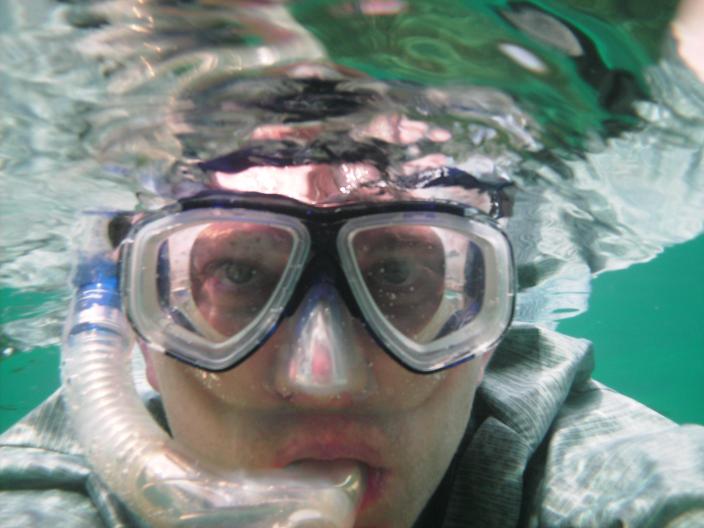
The author posing as a poser.
What is perhaps the only underwater panorama ever made! And not very
good at that...
Tasty looking coral.
The SL321 underwater camera shoots decent 320x240 movies - here's one!
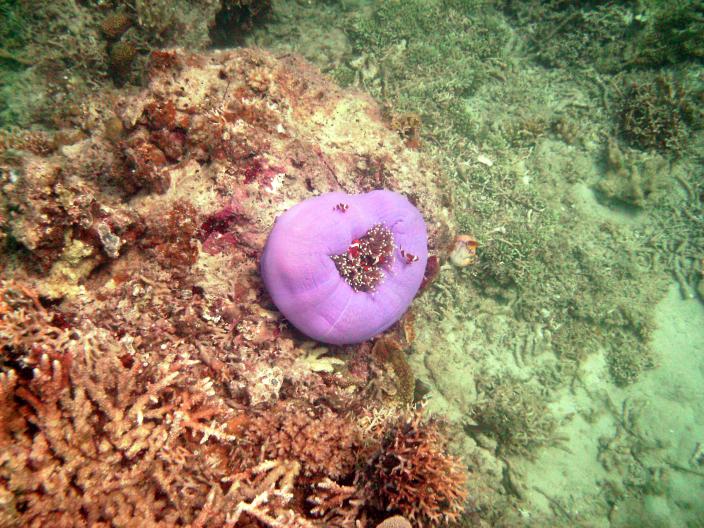
All the star fish I found were blue, and looked quite fake :o) probably
planted by resort officials...
This venomous Laticauda sea snake surprised and scared me. I followed
it for a while until it wrapped itself around a coral and as I departed
it, it reared up and observed me for some time. I later found
out they
rarely bite humans.
The *bus* powered boat propeller and rudder. Note the propeller was wrongly
installed inverted.
An isolated clown fish family and *bedding*.
0.8 meter (32 inch) jacks swimming endlessly in a figure eight 100
meters off the Miniloc resort (a more afforable Lagen sister resort).
A smaller clam - abundant.
Here's a resort boat *driver* showing a sea cucumber to a tourist -
honest, I was just snapping a picture of the mermaid, euh, sea slug,
euh...
Down the coast from Laoag and the Ilocandia fort is the old Spanish
town of Vigan
- apparently having lots of Spanish architecture still
intact. In the end it was a tourist trap to which numerous tour buses
ride for 90 minutes to dump there load onto tee shirt shops. I drove it
instead, and was quite exhausted upon returning to my hotel. This is
the tallest structure, a tower used centuries ago to command the
heights and watch out for Japanese invaders and others. Seems to me a
well placed shell from a Japanese destroyer would have dealt with it
simply.
Vigan is full of these donkey or horse driven carts - sad animals,
wobbling through messy traffic.